Ejecting Rover 2024 - 2025
20 May 2025 AD
Progression and repots from my 2024 - 2025 NASA HUNCH project
Overview
As a part of the 2024 - 2025 NASA HUNCH project, I had built an ejecting rover. The rover itself was to fit in a ~4'' cube and eject itself from a structure (a landed lunar module).

Final rover design cross section
The Good
The best part of my design, to me, was its novelty, creativity, and features. A good 80% of the effort I had put in went towards the custom PCBs I made, of which there were 3: a main control board with motor drivers, power management, and sensors. Further, the design itself, too, I was quite fond of. For some reason, I priortize looks an irrational amount, almost so much so as the functionality. The rover was compact, and had a relatively simple design from the outside with 2 little arms that made it sort of crawl around, and 2 mirrored plated on the top and bottom which the rover rested on, with these plates being able to rotate and thus turn the rover, as the 2 arms' movements on either side were not independent of each other, i.e., the arms only were responsible for moving the rover forwards and backwards, while the plates were responsible for turning.
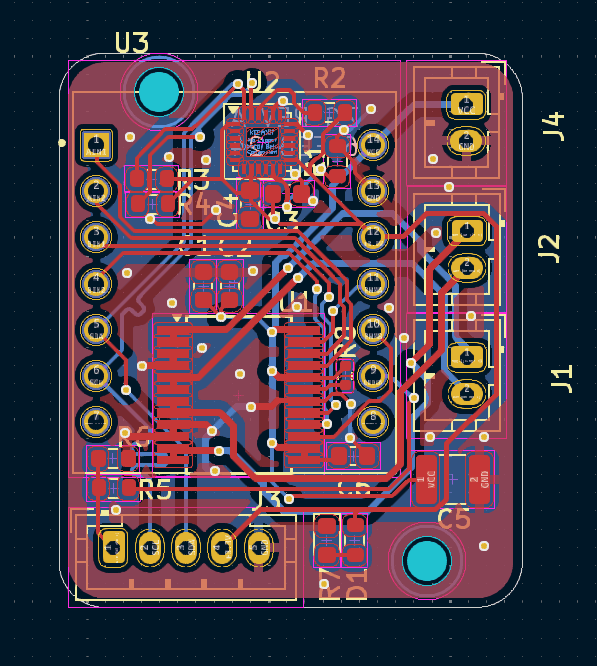
Main PCB with MCU and motor drivers. I know it's ugly!
The Bad
As incredible as 3D printing is, I believe it was ultimately to the detriment of my project. In something this small, the tolerances of 3D printing really start to show. Many of my parts, especially the linkage parts, were either too tight or too loose, and I had to do a lot of sanding and filing to get them to fit properly. Further, the strength of 3D printed parts is often questionable, especially when subjected to repeated stress cycles, as would be the case with my ejecting rover. Many of my parts ended up cracking or breaking after a few landings, which was incredibly frustrating. The PCBs, although mostly functional, were not great. This was my first time challening myself with them, and it shows. The worst offender is the power PCB, which I made when I had not concept of how to design a voltage booster, figuring you can just connect an inductor and some caps around an IC all across a PCB and either side haphazardly. Needless to say, it did not work, and I had to power the rover with a battery pack connected directly to the main PCB. Mechanically, the rover had a lot of issues as well. The screws used to tighten the bearing in the leg linkage would loosen themselves over time and fall out.
The Ugly
I think what ultimately killed me was that in the end, the orver didnt even work! The motor driver I was using, the TB6612, had a logic voltage input of 3.3V, but I had supplied it the motor voltage fo 7.4V! This had pretty much rendered the rover useless, as now I had to redesign the entire main PCB, which I did not have time for. Further, even if the motor driver had worked, I had not tested the jumping linkage enough to know if it would even work. I doon't even want to hink about how my ejection mechanism worked... I had made a crude container for the rover to sit in, with dovetailed rails that slid off the parent object. An electromagnet on the parent would be supplied some 40V in hopes of giving the box, which had a large magnet at its end, the most tiny little twitch on the rail, not even enough to overcome static friction. The steel casing of the electromagnet was attracting the magnet on the box more than the electromagnet was repelling the magnet on the box. It was a mess.
Conclusion
When it had come to present my project, I had to admit defeat, at least from the standpoint of the competition. (Incoming cliche about failure leading to success). Although I was disappointed that my rover did not work as intended, I learned a lot from the experience. I learned about the importance of prototyping and testing, especially for mechanical systems. I also learned about the challenges of working with small-scale systems, and the importance of considering manufacturing tolerances and material properties. Overall, while my ejecting rover may not have been a success in terms of functionality, it was a valuable learning experience that will undoubtedly inform my future projects. This was by far the most challenging project I have ever undertaken, and I am proud of the effort and creativity that went into it. At least I made one of the 15 honorable mentions for Texas! https://www.hunchdesign.com/uploads/2/2/0/9/22093000/northern_and_southern_texas_honorable_mentions_a.pdf
Asides
I was one of 4 chosen for an internship with NASA, but this did not go through because of NASA and Department of Education budget cuts. The Good the Bad and the Ugly is a great movie too (I don't use these headers just as clichés), but I prefer For a Few Dollars More. Hmm...